
Belangrijke potentieel ernstige bijwerkingen bij CAR T-celtherapie
Een veelvoorkomende bijwerking van CAR T-celtherapie is het potentieel ernstige CRS.1 Dit wordt gekenmerkt door overmatige pro-inflammatoire cytokine-afgifte dat ontstaat wanneer de CAR T-cellen reageren op een antigeen.4 CRS treedt meestal op binnen enkele dagen tot twee weken na de CAR T-cel infusie.5 Dit kan leiden tot symptomen zoals koorts, lage bloeddruk en problemen met zuurstofvoorziening.4,6
Wanneer patiënten na CAR T-celtherapie een temperatuur boven de 38 °C ontwikkelen, moet CRS worden overwogen, waarbij infecties moeten worden uitgesloten.4
ICANS is een reactie die doorgaans later optreedt dan CRS, maar vaak ook binnen de eerste 10 dagen na CAR T-celtherapie.5 Symptomen variëren van cognitieve stoornissen, delirium en taalproblemen tot ernstige stoornissen zoals convulsies of coma.4 De ernst van de symptomen worden uitgedrukt in een gradatie van 1-4.4,6
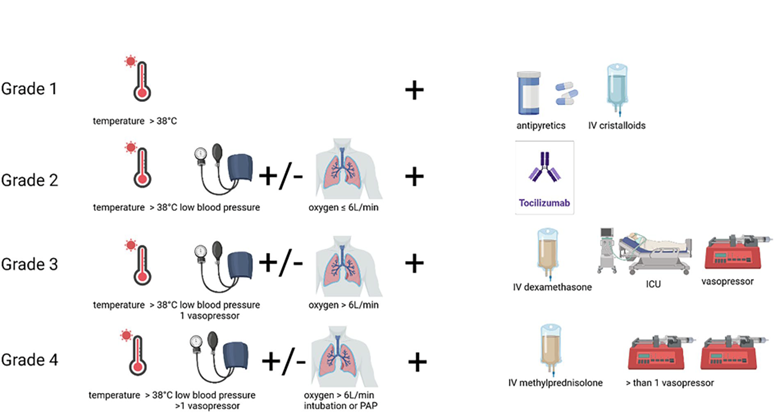
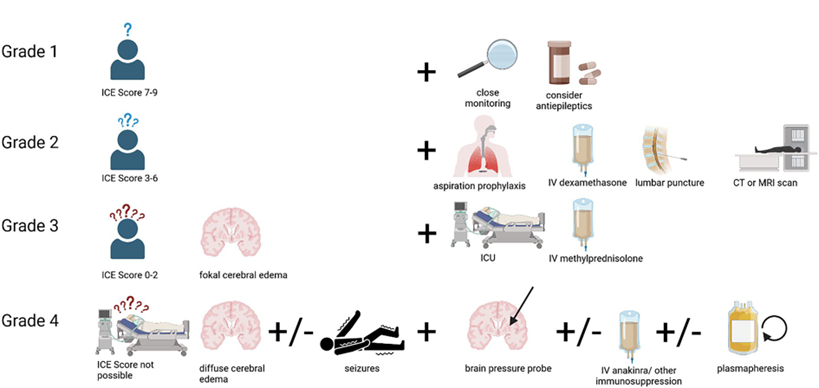
Definities CRS en ICANS
CRS: Een systemische inflammatoire respons veroorzaakt door de activering en expansie van CAR T-cellen, gekenmerkt door symptomen als koorts, hypotensie en hypoxie, variërend in ernst (Graad 1-4).4,6
ICANS: Neurologische toxiciteit die kan optreden na CAR T-cel infusie, vaak na CRS, met symptomen variërend van cognitieve stoornissen, delirium en taalproblemen tot ernstige verstoringen zoals convulsies of coma. De ernst van de symptomen wordt uitgedrukt in een gradatie (Graad 1-4).4,6
Schematisch diagram met de relatieve tijdschaal voor het begin en de duur van CRS en ICANS.5
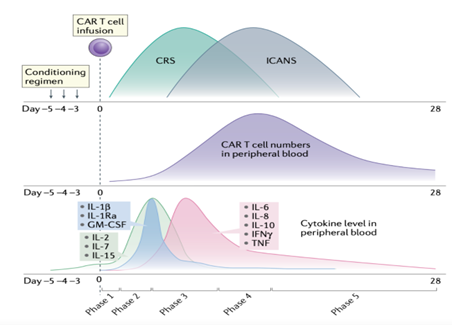
Overgenomen uit: Morris EC, et al. Cytokine release syndrome and associated neurotoxicity in cancer immunotherapy. Nat Rev Immunol. 2022 Feb;22(2):85-96. doi: 10.1038/s41577-021-00547-6.
Referenties
1. Chohan KL, et al. CAR T cell therapy: the efficacy and toxicity balance. Curr Hematol Malig Rep. 2023 April; 18(2): 9–18. doi:10.1007/s11899-023-00687-7.
2. Spanjaart AM, et al. The Dutch CAR-T Tumorboard Experience: Population-Based Real-World Data on Patients with Relapsed or Refractory Large B-Cell Lymphoma Referred for CD19-Directed CAR T-Cell Therapy in The Netherlands. Cancer (Basel). 2023. Aug 30;15(17):4334. doi: 10.3390/cancers15174334
3. Haidar G, et al. Infections after anti-CD19 chimeric antigen receptor T-cell therapy for hematologic malignancies: Timeline, prevention, and uncertainties. Curr. Opin. Infect. Dis. 2020, 33, 449–457.
4. Schroeder T, Martens T, Fransecky L, et al. Management of chimeric antigen receptor T (CAR-T) cell-associated toxicities. Intensive Care Med 50, 1459–1469 (2024). https://doi.org/10.1007/s00134-024-07576-4
5. Morris EC, et al. Cytokine release syndrome and associated neurotoxicity in cancer immunotherapy. Nat Rev Immunol. 2022. Feb;22(2):85-96. doi: 10.1038/s41577-021-00547-6.
6. Lee DW, Santomasso BD, Locke FL, et al. ASTCT Consensus grading for cytokine release syndrome and neurologic toxicity associated with immune effector cells. Biol Blood Marrrow Transplant 2019;25:625-38.
7. Hoogland AI, et al. Change in neurocognitive performance among patients with non-Hodgkin’s lymphoma in the first year after CAR T-cell therapy. Transplant Cell Ther. 2022 June ; 28(6): 305.e1–305.e9.
8. Riedel A, et al. Immunological consequences of CAR T-cell therapy: an analysis of infectious complications and immune reconstitution. Blood Adv (2025) 9 (13): 3149-3158. https://doi.org/10.1182/bloodadvances.2024015346
9. Hill JA, et al. How I prevent infections in patients receiving CD19-targeted chimeric antigen receptor T cells for B-cell malignancies Blood. 2020 Jun 24;136(8):925–935. doi: 10.1182/blood.2019004000
10. Johnson PC, et al. Longitudinal patient-reported outcomes in patients receiving chimeric antigen receptor T-cell therapy. Blood Adv (2023) 7 (14): 3541-3550.
11. Abramson JS, et al. Cytokine release syndrome and neurological event costs in lisocabtagene maraleucel-treated patients in the TRANSCEND NHL 001 trial. Blood Adv. 2021 Mar 23;5(6):1695-1705.
12. Azoulay E, et al. Outcomes in patients treated with chimeric antigen receptor T-cell therapy who were admitted to intensive care (CARTTAS): an international, multicentre, observational cohort study. Lancet Haematol. 2021;8:e355-64.
13. Bangol, A, et al. Comprehensive Review of Early and Late Toxicities in CART-Cell Therapy and Bispecific Antibody Treatments for Hematologic Malignancies. Cancers 2025, 17, 282. https://doi.org/10.3390/ cancers17020282
NO-NL-2500026
 icon below, scroll down and tap 'Add to Homescreen'.
Click 'Add' to install the app on your iPad.
icon below, scroll down and tap 'Add to Homescreen'.
Click 'Add' to install the app on your iPad.